If you are pricing up a civil water truck or reviewing your dust suppression fleet, the phrase "civil water tank" gets thrown around a lot — but the configuration that works for one project will not necessarily work for the next. Here is what experienced civil operators typically consider when speccing a water tank build for site work in Queensland.
This article is general context only — not engineering advice. The right specification for your build depends on your chassis, payload, operating environment, and site requirements. We work through those decisions with you directly before anything gets built.
What Is a Civil Water Tank Build?
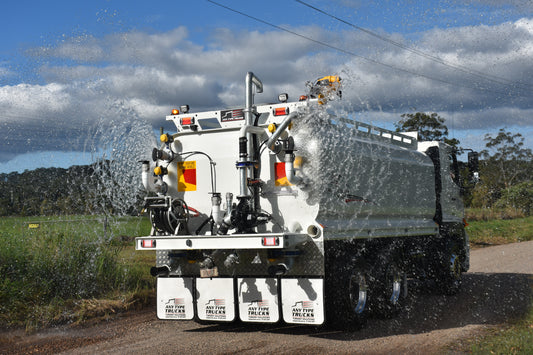
A civil water tank build refers to a water tank body purpose-mounted onto a cab chassis — typically a 4x2, 6x4 or 8x4 rigid truck — and configured specifically for civil construction and infrastructure applications. This is distinct from agricultural water tanks or static storage tanks. A civil water truck is a working asset: it moves, it sprays, it handles rough access roads, and it operates in environments where reliability is non-negotiable.
At Any Type Trucks, every civil water tank we build is engineered around your chassis, your payload capacity, and your specific site requirements. No two builds are identical.
Capacity: Matching Tank Size to Chassis Rating
Tank capacity needs to be matched to your chassis GVM, legal payload, and the duty cycle your operation demands. As a general guide, common configurations include:
- 7,000L–9,000L — commonly suited to 4x2 chassis: lightweight and agile, often used on tighter civil sites, residential subdivisions, and road construction work where manoeuvrability is a priority
- 12,000L–14,000L — a common civil spec on 6x4 chassis: a balance of capacity and refill frequency for road base compaction, earthworks and subdivision development
- 16,000L–18,000L — typically on 8x4 chassis: higher output for large-scale earthworks, highway construction, and projects with longer haul distances from fill points
These are indicative ranges only. Actual capacity depends on your chassis GVM, tare weight, and applicable compliance limits. We confirm the right configuration for your specific chassis before finalising the design.
Key Specification Decisions for Civil Water Tanks
Spray System
Front-mounted, rear-mounted, and side spray bars each serve different purposes. For civil dust suppression, rear gravity bars and front misters are commonly used. For road base wetting, a gravity dribble bar can deliver consistent coverage at low speed. Many builds include both configurations — switchable from the cab — to give operators flexibility across different task types. The right setup depends on your primary application.
Pump Selection
PTO-driven pump systems are commonly specified for heavy-duty civil applications. They deliver consistent flow rates and are generally straightforward to service in the field. For high-pressure applications such as dust cannon integration or pressure washing, hydraulic pump systems are often specified. The right pump configuration depends on your application and chassis — we work through this during the spec process.
Tank Material and Construction
Any Type Trucks civil water tanks are fabricated from high-grade steel — structurally integrated into the body frame with internal baffling to manage water movement on uneven terrain. We build in steel because it suits the structural integration approach we use and the operating conditions our clients typically work in. The right material choice for your application is worth discussing with your builder.
Fill System
Gravity-fill via top-mounted camlock is common for civil operations with access to standpipes or water carts. Self-fill via PTO pump — suction from waterways, dams or sumps — is available for remote sites without fixed water supply. The right configuration depends on where and how your truck will be refilled on site.
Compliance Considerations
Every ATT water truck build is engineered to VSB6 and ADR compliance as standard. For civil contractors working on government or Tier 1 infrastructure projects, compliance documentation is a common contract requirement. Our builds ship with full compliance documentation. For mine site work, site-specific compliance requirements vary — bring those to us at the start of the spec conversation.
Any Type Trucks is also Supply Nation Certified, which means our builds can directly satisfy Indigenous procurement requirements for clients with relevant government contracts or mining sector ESG commitments.
Talk to Our Team
If you are speccing a civil water tank build and want to work through chassis match, capacity, spray configuration or compliance requirements, our team does that with you before a single piece of steel is cut.
Contact Any Type Trucks or call 07 5476 8499.