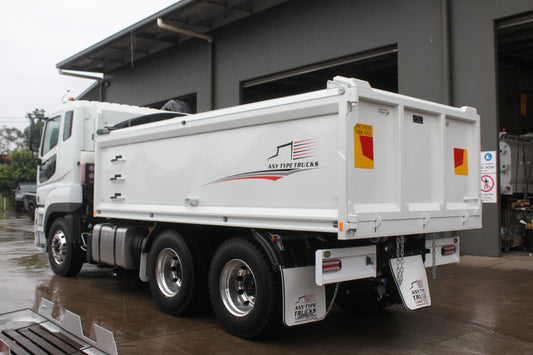
Getting the tipper body specification right matters — the right spec supports payload efficiency, long service life, and compliance on site. Getting it wrong can mean avoidable trade-offs in any of those areas. Here's what we work through with civil contractors when speccing a TB10 tipper body together.
Here's what we work through with every civil contractor when we're speccing a TB10 tipper body together. These are the conversations we have — not a substitute for them.
Every build is different. The right specification depends on your chassis, your payload, your operating environment, and your site requirements. This article is intended as general context only — not engineering advice. We work through the right specification with you directly.
1. Chassis First — Then the Body
The body has to work with the chassis, not against it. Before we start on body dimensions, we need to understand your GVM, wheelbase, intended payload, and how the vehicle will be operated. These inputs directly affect what we design and how we engineer the subframe interface.
This is why we ask for chassis specs early — not to be thorough for the sake of it, but because body design decisions flow directly from that information. A conversation up front avoids problems late.
2. Steel Grade — Hardox vs Mild Steel
For civil and quarry applications, we build the TB10 using Hardox wear-resistant steel. It offers high abrasion resistance and is significantly stronger than mild steel at equivalent thickness — which in practice means we can build a tougher body at a lower tare weight compared to a mild steel equivalent.
The actual weight saving varies depending on body dimensions, configuration, and chassis. We work through the numbers with you based on your specific build — but the principle holds: less tare weight means more payload on every load cycle.
- Hardox 450 — our standard for floor and sides. High abrasion resistance for aggregate, rubble, and overburden
- STRENX structural steel — high-strength structural members that reduce overall weight without sacrificing rigidity
3. Body Volume and Side Height
Volume needs to be matched to your payload and the materials you're carrying. We work from your legal payload limit and the density of your primary material to determine what internal volume makes sense for your application.
Side height is part of the same conversation. Lower sides suit faster loading with smaller machines. Higher sides work better for bulk material movement where volume per cycle matters more than loading speed. Neither is universally right — it depends on how the truck will actually be used on site.
4. Tailgate Configuration
A standard rear tailgate suits most civil applications. A two-way tailgate — which opens from either the top or the bottom — offers more flexibility in confined tipping situations. We discuss this based on where and how you'll be tipping, not as a default upgrade.
5. Site Compliance
All TB10 builds are completed in accordance with VSB6 and Australian Design Rules (ADR) as standard. For mine site work, we build to the specific compliance requirements of your site — including isolation kits, mine flags, wheel chocks, beacon lighting, and side access systems.
If you're operating under a specific heavy vehicle specification — such as Safer Together or a project-specific HVS — bring that to us at the start of the conversation. Compliance items that come up after a build is complete are expensive and avoidable.
6. Hydraulic System
We specify the hydraulic system based on your intended duty cycle and chassis PTO configuration. This is a conversation we have during the spec process — the right hydraulic setup for a truck doing 10 cycles a day looks different to one running continuous operations in a quarry environment.
Ready to Talk Through Your Next Tipper?
Any Type Trucks builds custom TB10 tipper bodies for civil contractors across Queensland and Australia. Every build starts with a proper conversation about your chassis, your payload, and your site — not a brochure, and not assumptions.
Talk to our team and we'll work through the right specification together.