
The Hazard That Catches Good Operators Out
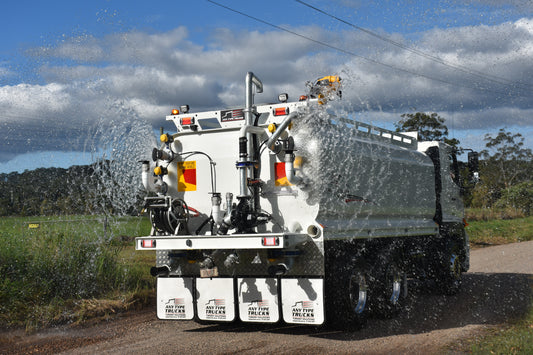
Water trucks are a critical part of civil, mining, quarrying, and infrastructure operations. They are also one of the most misunderstood heavy vehicles on site when it comes to risk.
Not because they are poorly designed.
Not because operators are careless.
But because liquid loads behave differently to anything else we move on wheels.
Across multiple transport sectors, dynamic liquid load behaviour is a recognised and actively managed hazard. Water operations are sometimes treated more informally, despite being governed by the same physics and capable of producing the same consequences.
Liquid Loads Obey the Same Physics—Regardless of What’s in the Tank
Water is not unique.
Industries transporting fuel, chemicals, and food-grade liquids have long acknowledged that liquid movement inside a tank directly affects braking, stability, and rollover risk.
Common examples include:
-
- fuel tankers operating under dangerous goods frameworks
- milk tankers where surge control is critical for stability and product protection
- chemical tankers where loss of control carries severe safety and environmental consequences
The difference is not the liquid itself.
The difference is how deliberately the risk is addressed.
Water does not burn or contaminate.
But a rollover at speed does not care what the tank contains.
Why Partial Loads Are Often Higher Risk Than Full Tanks
One of the most persistent misconceptions in water truck operations is that a partially filled tank is safer.
In practice, partial fills often create a higher-risk condition due to:
-
- increased free-surface effect
- greater surge energy under braking
- amplified lateral movement during turns
- delayed and unpredictable vehicle response
This is why incidents frequently occur at low speeds and during routine tasks. The truck feels manageable until the load shifts faster than the driver can compensate.
Rollover Risk Is a System Issue, Not an Operator Issue
When a water truck rolls, the focus often lands on the operator. Experience across liquid transport sectors shows this is rarely the full story.
Rollover risk emerges from the interaction of:
-
- centre of gravity and tank mounting height
- internal tank geometry and baffle effectiveness
- chassis, suspension, and braking characteristics
- haul road condition, cross-fall, and gradients
- scheduling pressure, fatigue, and exposure hours
Good operators work within the system provided. When that system does not adequately account for dynamic liquid behaviour, safety margins disappear quickly.
Engineering and Technology Help—But They Do Not Override Physics
Modern water trucks may incorporate advanced safety technologies such as:
-
- electronic braking and stability control systems
- digital inclinometers or tilt warning devices
- load monitoring systems
- in-vehicle monitoring and fatigue management tools
These technologies support awareness and decision-making.
They do not stop water from moving.
Across regulated liquid transport sectors, the primary control remains the same: anticipating load behaviour and operating within known limits, rather than relying on systems to recover a situation once it has developed.
Why Liquid-Specific Training Matters
Holding the correct licence does not automatically equate to competence in liquid load management.
Effective water truck operation requires:
-
- understanding surge and stability effects
- anticipating increased stopping distances
- avoiding abrupt steering corrections
- recognising early warning signs of instability
This is why many sites require liquid-specific training and verification, particularly where terrain, congestion, or duty cycles increase exposure.
Industry Guidance Exists for a Reason
Across Australia, industry bodies have consolidated learnings from serious heavy vehicle and bulk liquid incidents spanning multiple sectors.
Guidance such as the Safer Together Heavy Vehicle Specification highlights industry-recognised considerations relating to:
- bulk liquid load management
- dynamic vehicle stability
- operator competence and monitoring
- risk-based adoption of vehicle safety technologies
This guidance reflects a shared industry understanding that liquid load behaviour is a repeat contributor to serious incidents, regardless of whether the load is water, fuel, milk, or chemicals.
It is referenced here for general awareness only.
Interpretation, adoption, and application remain the responsibility of the relevant duty holders and must be addressed through site-specific risk assessment.
(Hyperlink “Safer Together Heavy Vehicle Specification (Rev 4.0)” to the PDF)
Why We Address This During Procurement and Handover
Historically across the industry, water truck discussions have focused primarily on capacity, layout, and delivery, with detailed risk considerations often addressed later at site level.
As operating environments have become more demanding and industry understanding of dynamic liquid load behaviour has matured, we have recognised the value of engaging earlier.
Our approach now acknowledges three fundamental realities:
- the physics of liquid movement is the same regardless of classification
- the consequences of loss of control or rollover can be just as severe
- warning signs of instability are typically present before failure occurs
In response, we are transitioning our model to introduce Risk Awareness & Industry Guidance during both the procurement phase and at handover for WT30 water trucks.
This transition aligns with how Any Type Trucks defines its Brand Pillars—Utility, Durability, Reliability, delivered with Class and Style—which guide how we design, build, and now engage earlier on risk awareness.
(You can read more about our Brand Pillars here: https://anytypetrucks.com.au/blogs/news/blogs-news-any-type-trucks-brand-pillars)
This information supports early, informed conversations between asset owners, employers, site controllers, and operators, allowing risk considerations to be factored into specification, deployment planning, and site systems from the outset.
It is not intended:
- to instruct how the vehicle is operated
- to mandate controls or systems of work
- to assume responsibility beyond design and manufacture
Its purpose is deliberate and forward-looking:
to ensure liquid-load risk is acknowledged during procurement and reinforced at handover, rather than discovered after an incident.
The Real Takeaway
Fuel, milk, chemical, and water tankers all obey the same rules of motion.
The organisations with the strongest safety outcomes are not those with the most rules, but those that respect liquid behaviour and design their systems accordingly.
Control does not come from confidence or speed.
It comes from understanding what the load is doing when the truck is asked to slow down, turn, or stop.
That understanding is where safety, productivity, and asset longevity intersect.
Any Type Trucks designs and builds custom transport equipment for civil, mining, and hire fleet operators across Queensland and Australia. Talk to our team or call 07 5476 8499.